For Indian doctors and dentists on H-1B visas, the idea of owning a clinic is no longer just a long-term dream—it’s becoming a strategic move tied directly to immigration, financial growth, and professional independence.
But once physicians begin seriously evaluating the EB-5 path, one question quickly becomes critical:
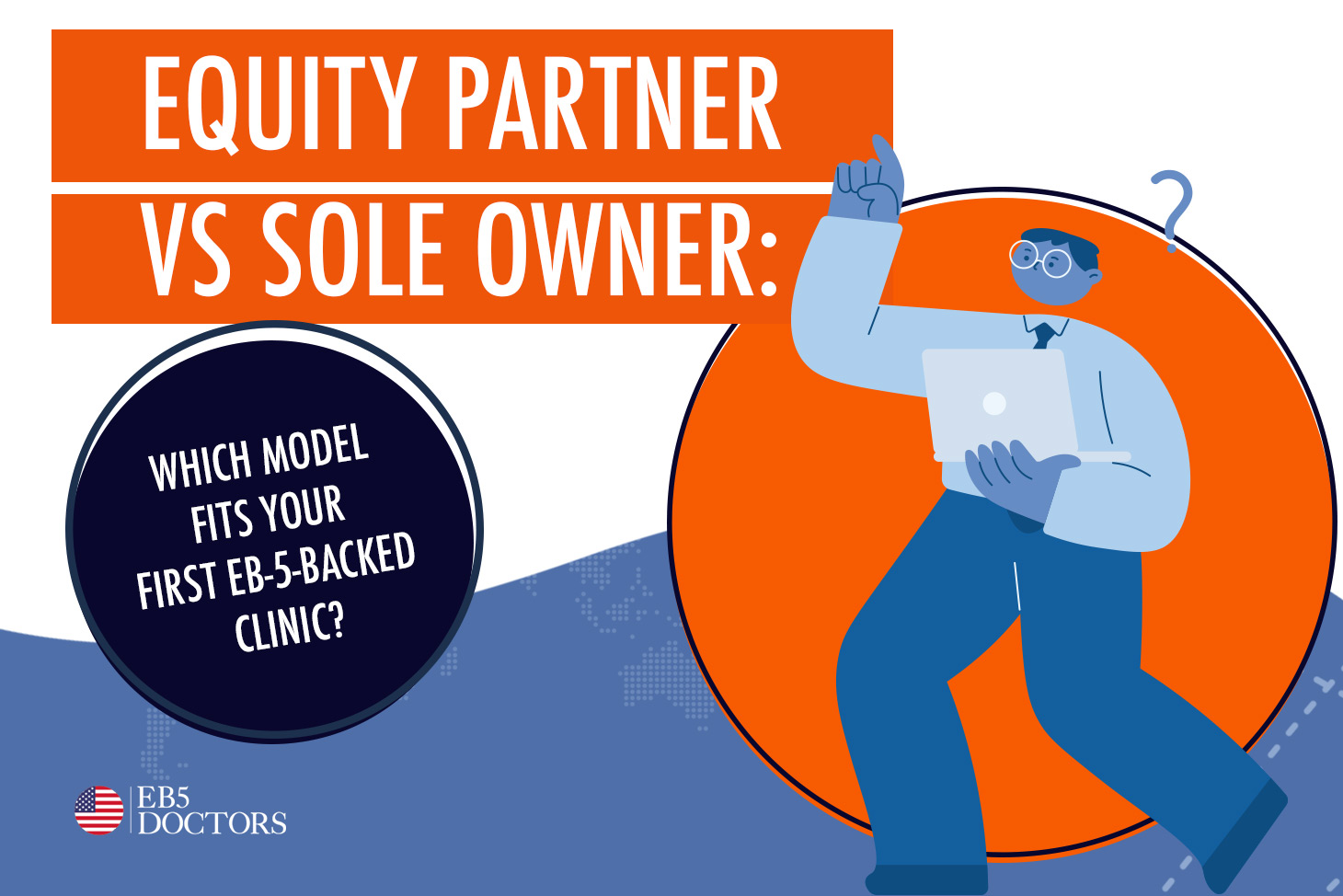
Should you start as an equity partner—or build as a sole owner from day one?
It sounds like a business decision. In reality, it impacts almost everything:
- your capital requirements
- your operational workload
- your execution timeline
- your stress level
- your immigration strategy
- and your long-term scalability
The right answer is rarely about prestige. It’s about choosing the structure that best aligns with what you can realistically execute while building toward long-term ownership goals.
Let’s break it down.
Why This Decision Matters Early
Many physicians initially focus on:
📍 location
⏳ Green Card timing
💰 EB-5 investment requirements
🏥 specialty demand
All important.
But ownership structure often shapes the entire execution path more than physicians realize.
Because your structure determines:
- how decisions are made
- how much support exists around you
- how quickly the clinic can launch
- how much financial exposure you carry
- how operationally complex your first few years become
At EB5 Doctors, we’ve seen one thing consistently:
👉 Physicians who choose a structure aligned with their actual execution capacity tend to move faster, experience less operational friction, and build more stable clinics.
What an Equity Partner Model Can Offer
An equity partner model means ownership is shared between you and one or more partners—often including experienced operators, DSOs, MSOs, or strategic healthcare groups.
For many first-time physician owners, this can create a more structured entry point into practice ownership.
1️⃣ Shared Control
You maintain meaningful ownership involvement while sharing certain strategic and operational decisions.
That may include:
- expansion planning
- staffing decisions
- operational budgeting
- vendor relationships
- administrative systems
For physicians used to practicing medicine—not running infrastructure—this shared structure can reduce early overwhelm.
2️⃣ Shared Upside
You may not retain 100% of profits or equity growth, but you also avoid carrying 100% of the risk and operational pressure alone.
For many physicians, especially those balancing:
- immigration planning
- family responsibilities
- clinical workload
- business ownership for the first time
…this tradeoff creates a more manageable growth path.
3️⃣ Built-In Operational Support
This is one of the biggest advantages of partnership structures.
Depending on the setup, physicians may receive support with:
✅ staffing
✅ billing and collections
✅ HR systems
✅ compliance
✅ vendor contracts
✅ clinic buildout
✅ operational processes
✅ administrative infrastructure
That support often allows physicians to focus more heavily on:
- patient care
- clinical quality
- growth strategy
- EB-5 compliance milestones
instead of handling every operational detail personally.
4️⃣ Lower Upfront Capital Requirement
This is one of the most overlooked differences between ownership structures.
With a traditional sole ownership model, physicians often need to fund:
- the full EB-5 investment requirement
- clinic startup costs
- equipment
- staffing
- leasehold improvements
- operational reserves
- legal and administrative setup
That can push the total required capital to approximately:
💰 $800K–$860K+ upfront
depending on specialty, market, and clinic structure.
By contrast, certain partnership structures through EB5 Doctors may allow physicians to begin with approximately:
💰 $200K–$260K upfront
while leveraging:
- shared infrastructure
- operational partnerships
- strategic capital support
- DSO/MSO relationships
For many physicians, this dramatically changes:
- execution speed
- financial pressure
- personal risk exposure
- flexibility during the immigration process
This doesn’t mean partnership is “better.” It simply means the financial burden may be more manageable during the earliest and riskiest phase of clinic ownership.
Tradeoffs of the Equity Partner Model
No structure is perfect.
Potential tradeoffs include:
⚠️ Reduced autonomy
⚠️ Shared decision-making
⚠️ Profit sharing
⚠️ Less control over operational direction
⚠️ Potentially slower consensus-driven decisions
For physicians who value total independence immediately, these limitations can feel restrictive.
What Sole Ownership Can Offer
For some physicians, sole ownership represents the ultimate goal:
complete control, full independence, and long-term wealth creation.
And there are real advantages to that path.
1️⃣ Maximum Control
As sole owner:
- every strategic decision is yours
- every operational process is yours
- every expansion decision is yours
You control:
- branding
- hiring
- growth strategy
- patient experience
- future partnerships
- long-term business direction
For entrepreneurial physicians, that level of autonomy can be extremely attractive.
2️⃣ Full Economic Upside
You retain:
✅ full equity growth
✅ full profit potential
✅ full practice valuation appreciation
If the clinic performs well long-term, the upside can be substantial.
3️⃣ Long-Term Flexibility
You can:
- expand locations
- add providers
- bring in partners later
- restructure ownership
- sell the practice
- build a multi-location platform
without requiring partner approval.
For physicians with a larger entrepreneurial vision, sole ownership may align better over time.
The Reality Check on Sole Ownership
This is where physicians need to think carefully.
Because full ownership also means full responsibility.
⚠️ Full Operational Burden
You are responsible for:
- staffing
- payroll
- compliance
- billing systems
- credentialing
- vendor negotiations
- daily operational oversight
- financial management
There’s no built-in infrastructure unless you create or hire it.
⚠️ Higher Upfront Capital Requirement
Unlike structured partnership models, sole ownership often requires physicians to independently shoulder:
- the full EB-5 investment
- startup expenses
- staffing costs
- operational reserves
- infrastructure costs
That frequently means:
💰 $800K–$860K+ required upfront
For many first-time physician owners, this creates:
- greater financial pressure
- higher personal exposure
- slower launch timelines
- reduced flexibility during the immigration process
⚠️ Greater Execution Risk
Owning a clinic is not just a clinical challenge—it’s an operational business challenge.
And for physicians simultaneously navigating:
- EB-5 requirements
- immigration timelines
- family transitions
- business operations
…the pressure can become significant very quickly.
Questions Physicians Should Ask Before Choosing
There’s no universally correct structure.
The right model is the one that aligns with:
- your goals
- your timeline
- your financial comfort
- your operational readiness
Here are the questions that matter most:
1️⃣ How much operational support do I realistically need right now?
Support is not weakness.
Sometimes it’s the smartest way to execute faster and more safely.
2️⃣ How important is full control in Year 1 vs Year 5?
Some physicians want full ownership eventually—but may benefit from partnership during the early stages.
3️⃣ What can I actually execute well today?
Not aspirationally.
Realistically.
Do you:
- understand clinic operations deeply?
- have leadership infrastructure?
- want to manage every operational layer immediately?
4️⃣ What structure best fits my specialty and market?
Certain specialties require:
- larger staffing structures
- more operational coordination
- heavier administrative systems
In some markets, partnerships create much smoother execution.
5️⃣ What does my personal timeline look like?
Consider:
- family responsibilities
- financial stress tolerance
- immigration timing
- career stage
- lifestyle goals
Your ownership structure should support your life—not consume it.
What EB5 Doctors Evaluates When Guiding This Decision
At EB5 Doctors, we don’t believe one model fits everyone.
We help physicians evaluate:
✅ ownership goals
✅ market fit
✅ execution readiness
✅ immigration timing
✅ operational complexity
✅ financial structure
✅ scaling potential
✅ execution risk
Through our network of:
- DSOs
- MSOs
- legal professionals
- capital partners
- operational advisors
we help physicians structure ownership models aligned with both:
📌 EB-5 compliance
📌 real-world clinic execution
Final Thoughts
It’s easy to assume:
👉 “More ownership automatically means a better opportunity.”
But that’s not always true.
Because more ownership also means:
- more operational burden
- more capital exposure
- more execution pressure
- more responsibility from day one
The best ownership structure is not the one that sounds the most impressive.
It’s the one you can execute confidently while building toward your long-term vision.
For some physicians, that’s sole ownership immediately.
For others, partnership creates a faster, safer, and more strategic entry point into ownership.
The key is choosing intentionally—not emotionally.
Ready to Explore Which Structure Fits You Best?
📞 Schedule a strategy call with EB5 Doctors
👉 www.eb5doctors.com
Let’s evaluate:
- your goals
- your timeline
- your market
- your investment strategy
- and the ownership structure that best supports your path forward.